
Find your next career move
Welcome to Public Sector People, your gateway to exciting career opportunities in Australia.
As a trusted recruitment agency, we are committed to guiding and supporting you in your job search, helping you find the perfect fit for your skills, experience, and aspirations.
At PSP, we understand that finding the right job is crucial to your professional growth and happiness. Our mission is to be your trusted partner throughout your career journey, offering personalised guidance, valuable insights, and access to a wide range of opportunities across various industries and positions.






Featured blogs
Keep updated with the latest news.

Australia’s for-purpose sector plays a critical role in supporting communities, delivering services and addressing some of the country’s most complex social challenges. From housing and healthcare to education, disability services and community programs, thousands of organisations operate with a shared goal: to create positive social, cultural or environmental impact. But while the sector is often grouped under one umbrella, it is made up of distinct organisation types with different structures, funding models and operating approaches. Understanding these differences is important for professionals working in or entering the sector, and for organisations looking to attract the right capability. What is a for-purpose organisation? A for-purpose organisation is any organisation that exists primarily to deliver social, community or environmental outcomes rather than distribute profit to shareholders. This includes: Charities Not-for-profits (NFPs) Social enterprises Community service organisations Advocacy and policy bodies While some generate revenue through services or trading activities, profits are typically reinvested back into their mission. Registered charities Charities are formally registered with the Australian Charities and Not-for-profits Commission (ACNC ). To maintain this status, organisations must demonstrate that their purpose aligns with recognised charitable objectives such as: · Advancing health · Education · Social or public welfare · Religion · Environmental protection · Relief of poverty or distress Charities often rely on: · Donations · Grants · Government funding · Fundraising activities They play a significant role in delivering frontline support services, particularly in areas such as homelessness, mental health, domestic violence support and community care. Not-for-profit organisations Not-for-profits operate without the intention of distributing profits to owners or shareholders. Instead, all income is reinvested into the organisation’s purpose. NFPs can include: · Membership organisations · Community groups · Industry bodies · Service providers While many NFPs are also registered charities, not all not-for-profits are classified as charities. NFPs may focus on: · Advocacy and representation · Community programs · Service delivery · Professional or industry support Social enterprises Social enterprises are organisations that use commercial business models to achieve social or environmental outcomes. Unlike traditional charities or NFPs, they may generate profit through trading goods or services, but that profit is reinvested into their mission. Examples include: · Employment programs supporting disadvantaged groups · Ethical retail businesses · Environmental sustainability initiatives · Training and skills development organisations Social enterprises sit at the intersection of business and impact, blending commercial discipline with purpose-driven outcomes. Community service organisations Community service organisations deliver essential programs and support directly to individuals and communities. These organisations often work in partnership with government agencies and may deliver services such as: · Disability support · Youth services · Aged care support · Family and domestic violence services · Housing and homelessness programs They are a critical part of Australia’s social infrastructure. Advocacy and policy organisations These organisations focus on: · Research and analysis · Policy development · Advocacy and awareness · Representing community interests They may not always deliver frontline services but play an important role in shaping public debate and influencing government decisions. Government and the for-purpose sector The for-purpose sector and government are deeply interconnected. Many services are delivered through partnerships between: · Government departments · Local councils · Charities · Not-for-profits · Community organisations This creates ongoing demand for professionals who can operate effectively across complex environments, manage stakeholders and deliver outcomes in regulated settings. Careers in the for-purpose sector Roles span across: · Leadership and executive management · Program and project management · Policy and advocacy · Community engagement · Finance and operations · HR and governance · Service delivery Professionals are often drawn to the sector because of its combination of purpose, complexity and community impact. The for-purpose sector is diverse, complex and essential to how communities function across Australia. Whether working in a charity, not-for-profit, social enterprise or government-funded program, professionals in this space share a common goal: delivering outcomes that matter.

Public sector leadership is a different kind of leadership. Across Australia, public sector organisations deliver essential services and outcomes at enormous scale. The Australian Public Service alone employed 198,529 people across 102 agencies in 2025 , highlighting the size, diversity and complexity of the environment in which public sector leaders operate. The decisions are rarely straightforward. Priorities can compete, expectations can shift and the consequences of getting a decision wrong can extend well beyond the organisation itself. Public sector leaders are accountable to their teams, their stakeholders and the communities they serve. They also operate within legislative, regulatory, and political environments that can add layers of complexity to even the most strategic decisions. In this environment, effective leadership isn't simply about having the experience to make decisions. It is about knowing how to navigate complexity, build trust, manage competing interests and turn strategy into meaningful outcomes. Leadership when there is no simple answer In many organisations, leadership is measured by the ability to set a direction and deliver results. In the public sector, the path to those results can be considerably more complex. Leaders may need to balance community expectations with government priorities, manage finite budgets while meeting rising demand, or drive transformation while maintaining essential services. There may not be a perfect solution. Instead, leaders need to assess the information available, understand the broader implications of a decision and have the confidence to act, while being prepared to explain and stand behind that decision. That requires a different level of judgement. The ability to bring people with you Successful outcomes often depend on the ability to work across departments, agencies, government, communities and other stakeholders and rarely about making decisions in isolation. A technically sound strategy can still fail if the people responsible for delivering it don't understand it, support it or see how it will work in practice. Strong leaders recognise that communication isn't something that happens after a decision has been made. It is part of the decision-making process itself. They create clarity in uncertain environments, listen to different perspectives and build confidence around a shared direction. That ability to bring people with you becomes particularly important during periods of significant change. Leading through change and increasing complexity Public sector organisations are facing significant shifts in how they operate and deliver services. Digital transformation is changing the way services are designed and delivered. Workforce pressures are creating capability challenges. Community expectations continue to evolve. At the same time, organisations are expected to achieve more while making careful resource decisions. Change itself is no longer unusual. The challenge is leading effectively while change continues. This requires leaders who can remain strategic without losing sight of operational realities. They need to adapt when circumstances change, maintain momentum when progress is difficult and give their teams confidence when the path ahead isn't completely clear. Resilience matters, but so does adaptability. Experience matters, but context matters too Leadership experience is valuable, but experience alone doesn't necessarily translate into effective public sector leadership. The context in which someone has led matters. This is becoming increasingly important as the public sector workforce evolves. In June 2025, 18.9% of Australian Public Service employees were aged 55 or over . That’s more than 37,000 people. As experienced employees move into the later stages of their careers, organisations need to think carefully about succession, knowledge transfer, and how to retain critical institutional expertise. A leader may have an impressive track record in a commercial environment, but stepping into the public sector can require a different understanding of accountability, governance, stakeholder management and decision-making. Likewise, someone with deep public sector experience may bring an understanding of the environment that enables them to navigate complexity more effectively from day one. The strongest appointments consider both capability and context. It is not simply about finding someone who can lead. It is about finding someone who understands what leadership requires in that particular environment while ensuring the organisation has the capability to meet what comes next. Turning complexity into outcomes There is no single formula for effective public sector leadership. The strongest leaders understand that complexity is part of the job. They are comfortable making decisions without perfect information, can balance competing perspectives, and are willing to take accountability for outcomes. Most importantly, they understand that leadership is ultimately about people. It is about creating clarity, building trust and giving teams the confidence to move forward, even when the environment around them is changing. At Public Sector People , we understand the unique leadership and capability challenges facing public sector organisations. We work with organisations to identify and connect them with the specialist people they need to deliver today and prepare for what comes next.
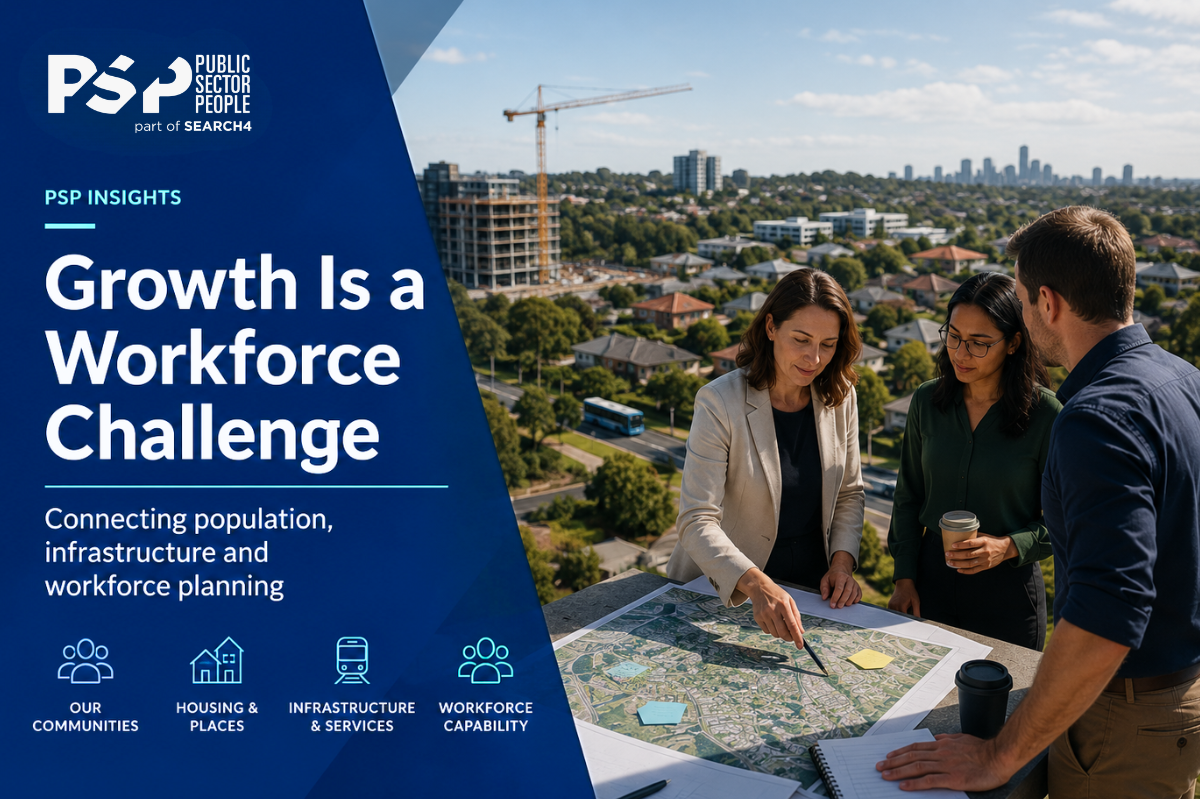
By Tom Goater, National Accounts Director, Public Sector People A few weeks ago, I attended the Australian Local Government Association National General Assembly in Canberra, where one of the standout sessions at the Urban Forum came from Simon Kuestenmacher of The Demographics Group. Simon has a rare ability to make population data feel less like a spreadsheet and more like a preview of what is heading our way. While his presentation focused primarily on urban Australia, the implications extend well beyond local government. The central message was clear: Australia is likely to continue growing and prospering, but that growth will place increasing pressure on housing, infrastructure, public services and, importantly, the workforce expected to deliver them. Australia’s long-term outlook remains strong Australia’s economy may be relatively simple compared with some global economies, but mining, agriculture, tourism, international education and our proximity to Asia’s growing middle class continue to work in our favour. Migration also gives Australia an advantage over many other developed economies by helping replenish the working-age population. However, more people also means greater demand for housing, services and infrastructure, as well as higher expectations of government. Australia’s population is not simply growing. It is moving, ageing and reshaping our cities at the same time. Growth will remain concentrated around major cities Inner-city areas will continue to attract migrants, international students and other new arrivals. Urban-fringe communities are likely to absorb more families looking for larger and more affordable homes, while established middle suburbs may experience some of the most significant change as larger properties are gradually redeveloped into higher-density housing. These changes will create different challenges across different communities. While some areas will need to accommodate rapid population growth, others will face ageing populations, changing service requirements and the renewal of established infrastructure. The impact will be felt across every level of government For local councils, population growth means increasing demand across planning, roads, transport, open space, waste, libraries, aquatic centres, community facilities and ageing infrastructure. For state governments, it means balancing ambitious housing targets with investment in transport, health, education and utilities, while maintaining community confidence in the planning system. For the Commonwealth, it means recognising that migration, skills, housing, infrastructure funding and productivity policy are deeply interconnected. Decisions made in one area will inevitably affect delivery in another. The workforce challenge may be as significant as the housing challenge Australia’s population is ageing, large numbers of experienced workers are approaching retirement and demand for government services will continue to rise. Aged care may be one of the most visible examples, but similar workforce pressures are being experienced across planning, engineering, health, technology, infrastructure, project delivery, community services and public administration. Government organisations will increasingly be expected to deliver more with a workforce that is becoming harder to find. This makes workforce planning just as important as infrastructure and land-use planning. It also makes AI, automation and digital transformation increasingly important—not simply as cost-saving initiatives, but as practical tools that can help a constrained workforce remain productive and continue delivering essential services. Growth is likely to happen regardless For councils and other government organisations, the opportunity is to remain involved in shaping that growth. Councils that engage early with developers, state agencies and their communities will have a stronger opportunity to influence where growth occurs, what infrastructure supports it and how local liveability is protected. Those left outside the process may still find themselves responsible for managing the consequences. This makes early collaboration, long-term planning and clear communication essential. An opportunity for government employers The presentation also challenged the assumption that younger workers are inherently less loyal. Housing costs and reduced geographic mobility mean many younger Australians are changing jobs less frequently and looking for employment opportunities closer to home. Government may not always compete with the private sector on salary alone, but it can offer purpose, stability, flexibility, professional development and the opportunity to make a visible contribution to the community. That is a compelling employee value proposition, provided government organisations are confident enough to promote it and can deliver a positive candidate and employee experience. Connecting population, infrastructure and workforce planning The biggest takeaway from the session was that none of these challenges can be addressed in isolation. Housing policy affects workforce mobility. Migration policy affects infrastructure demand. Planning decisions affect service delivery. Technology affects productivity. Ultimately, workforce capability determines whether governments can deliver the commitments they have made. Australia’s future remains full of opportunity, but making the most of it will require stronger coordination across all levels of government and a much closer connection between population planning, infrastructure planning and workforce planning. Growth is not only a planning challenge. It is a workforce challenge. Turning insight into workforce capability For government organisations considering what these trends mean for their delivery plans, the next step is turning demographic insight into practical workforce capability. This means looking beyond immediate vacancies and considering the skills, leadership capacity and specialist expertise that will be required over the coming years. At Public Sector People, we work exclusively with government and for-purpose organisations, supporting workforce requirements across permanent recruitment, temporary and contract appointments, executive search and specialist project delivery. Our teams partner with organisations across Australia to understand their workforce challenges, identify critical capability gaps and provide recruitment solutions aligned with both immediate delivery requirements and longer-term workforce plans. Whether an organisation is responding to population growth, delivering new infrastructure, managing service demand or preparing for a changing workforce, early workforce planning will be essential.

Acting arrangements have long been a valuable workforce tool across the public sector.

Why Role Design in the For Purpose Sector is Becoming a Critical Capability

For professionals considering a move into the Government sector, one of the first things they notice is that salary structures differ from those in the private sector. Rather than individually negotiated salaries, most public sector roles sit within defined classification frameworks or salary bands. These systems are designed to provide transparency, consistency and fairness across agencies. While the naming conventions vary across federal, state, and local government, the underlying concept is similar: roles are grouped by responsibility, expertise, and leadership scope , with salary progression built into each level. Federal Government: Australian Public Service (APS) The Australian Public Service uses a nationally recognised classification framework across federal departments and agencies. Typical APS levels include: APS1–APS3 Entry-level and operational roles providing administrative or technical support. APS4–APS5 Advisory and specialist roles across policy, program delivery, administration and technical disciplines. APS6 Senior advisors and team leaders with greater responsibility for decision-making and stakeholder management. Executive Level 1 (EL1) Managers responsible for leading teams, programs or major policy areas. Executive Level 2 (EL2) Senior leaders managing significant functions, projects or strategic initiatives. Senior Executive Service (SES) Executive leadership responsible for large divisions, national programs and organisational strategy. Within each classification level, employees typically progress through incremental salary steps as they gain experience and capability. State Government Classification Frameworks Each state government maintains its own classification system, although many follow a similar progression from operational roles through to senior leadership. For example: New South Wales Government Roles are commonly structured using Clerk Grades , such as: Clerk Grade 5/6 Clerk Grade 7/8 Clerk Grade 9/10 These classifications generally reflect increasing responsibility, policy influence and leadership scope. Queensland Government Many roles fall under Administrative Officer (AO) or Professional Officer (PO) classifications. Examples include: AO3–AO4: operational and administrative roles AO5–AO6: advisors and specialists AO7–AO8: senior advisors and managers Victoria Government The Victorian Public Service uses the VPS classification framework , including: VPS2–VPS3: operational roles VPS4–VPS5: advisors and specialists VPS6: senior management and program leadership While titles vary between states, the frameworks all aim to align salary with responsibility, complexity and leadership scope. Local Government (Councils) Local councils typically use banded salary structures through enterprise agreements, rather than national classification systems. Most council roles are grouped within bands that broadly align with the complexity and responsibility of the role. Examples may include: Band 3–4 Operational roles or technical support positions. Band 5–6 Professional roles such as planners, analysts, project officers and specialists. Band 7–8 Senior leadership roles managing teams, programs or strategic initiatives. Because councils vary widely in size and structure, the exact banding and salary ranges can differ between organisations. Understanding Salary Bands Matters For professionals exploring careers in the public sector, understanding classification structures can provide valuable clarity. Salary band frameworks help candidates: Compare roles across different government levels Understand progression pathways within the public sector Set realistic expectations when applying for roles While the terminology differs across jurisdictions, the core principle remains the same: public sector salary structures are designed to align remuneration with responsibility, capability and impact. For many professionals, these frameworks also provide clear career progression pathways within government. Get in touch Explore jobs available
Candidate feedback
Follow us!
Job Sectors
All content copyrighted | Privacy Policy | Cookie Policy | T&Cs | Powered with 💙 by Shazamme